Rope course or 3D maze – which should you choose? A rope course suits active visitors looking for adrenaline and a physical challenge. A 3D maze appeals to a much wider audience, from young children to grandparents, and costs the operator less time and money. The main difference lies not in the experience, but in day-to-day operation. A rope course needs trained staff and a safety briefing, while a 3D maze runs almost on its own.
What do a rope course and a 3D maze have in common?
Both are elevated structures for active outdoor play. They stand on timber or steel poles, or can be anchored to existing trees using a non-invasive method. Their construction and safety requirements are based on the same standard, EN 15567-1:2015+A1:2020. Both can also be extended over time with new routes, obstacles, a slide or a zipline. Where they differ fundamentally is in how they are run and who they attract.
How does a rope course operate?
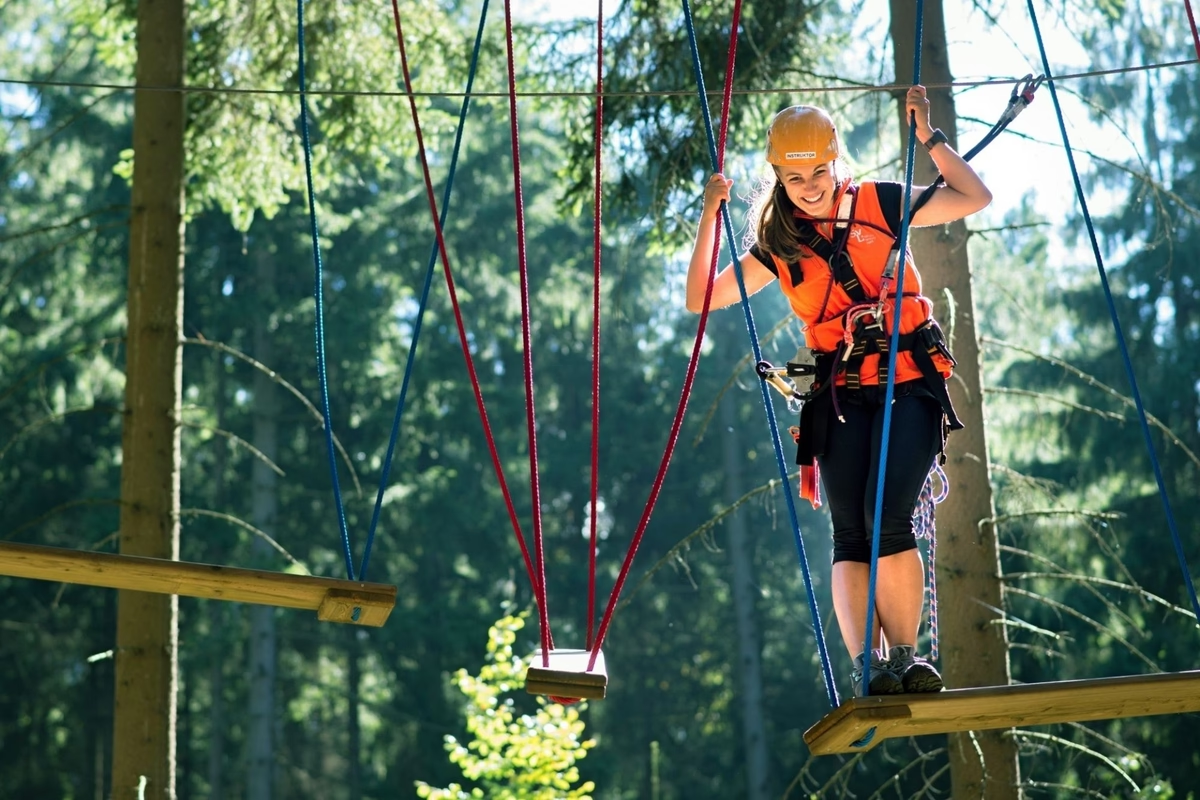
A classic rope course relies on personal fall protection. Every visitor wears a harness and stays clipped to a rope or steel safety line along the whole route. Before setting off, they must complete a safety briefing led by a trained instructor. Rope course operation, including belaying and the role of instructors, is covered by the related standard EN 15567-2:2015.
In practice, this means permanent staff on every shift. Instructors hand out and check equipment, supervise the route and must be ready to help a visitor who gets stuck at height. Capacity therefore depends not only on the number of obstacles, but also on how many people are on duty. Every extra instructor means extra wage costs.
Why is a 3D maze easier to run?
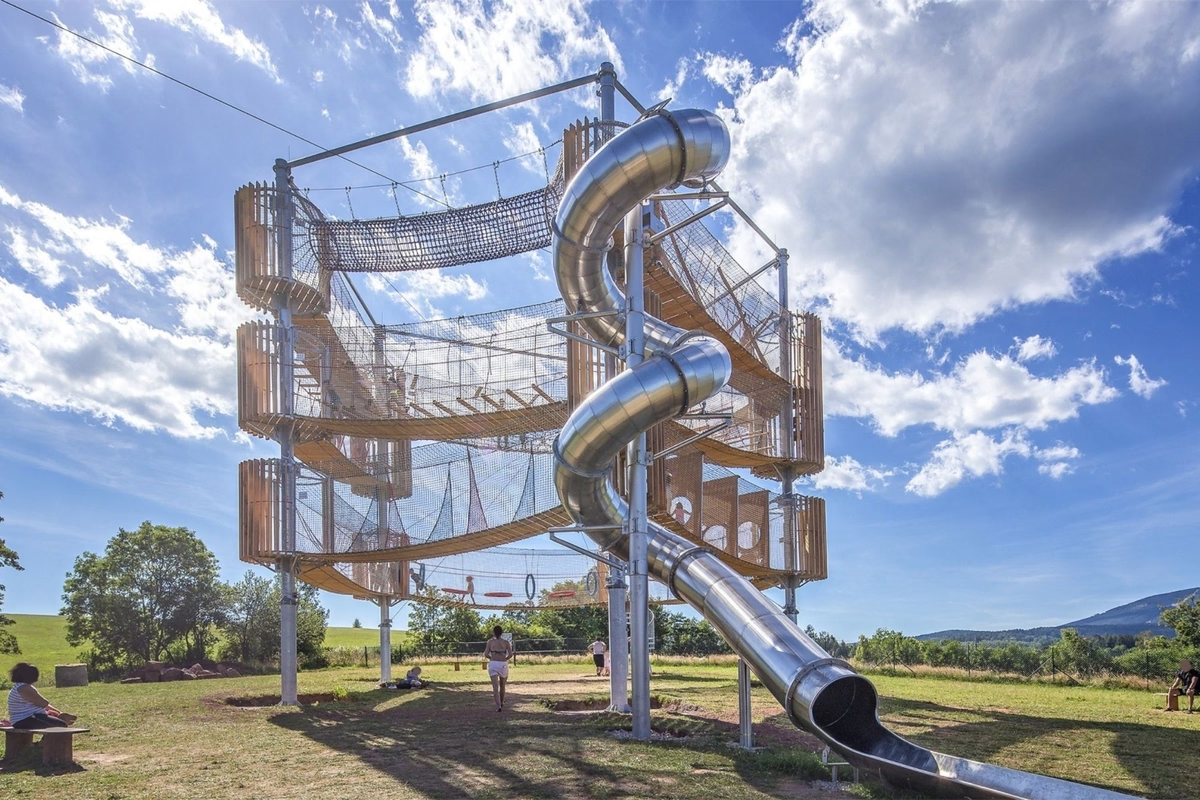
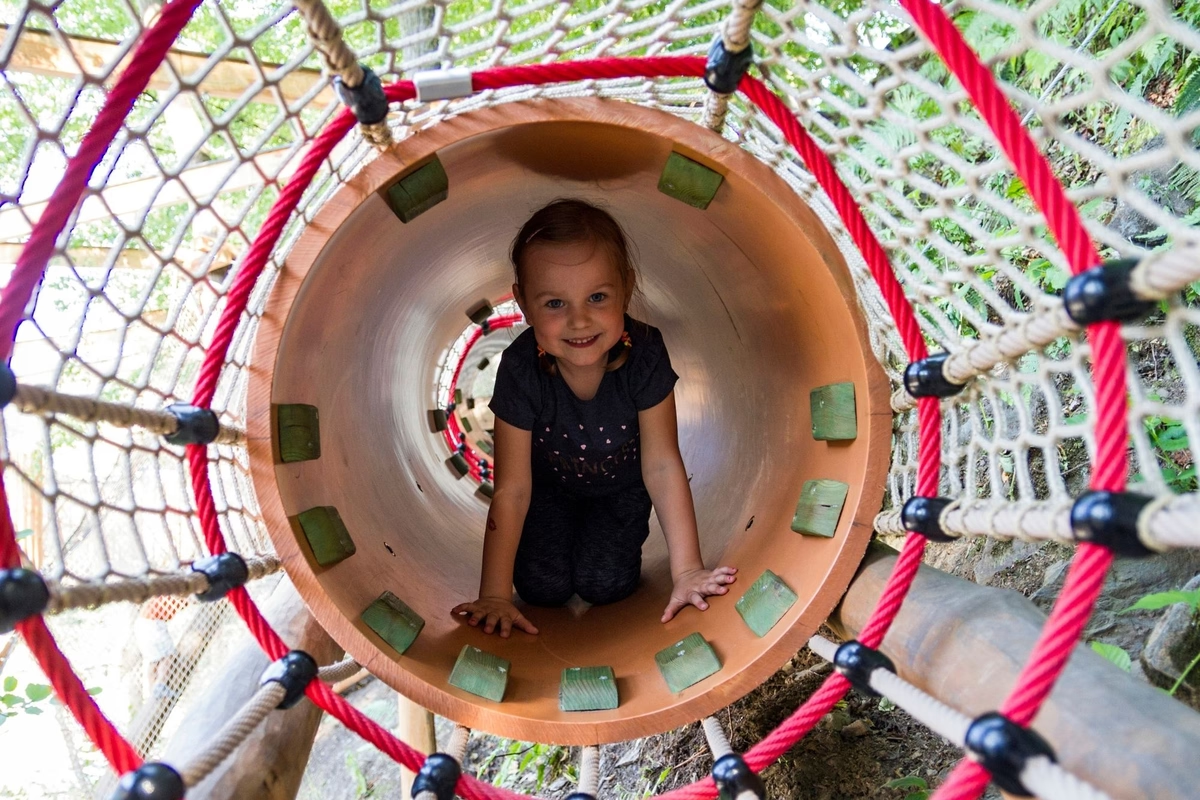
A 3D maze is a multi-level attraction made of suspended walkways, transition houses and obstacles. The entire route is enclosed by nets on all sides. Visitors need no harness or continuous belay system, and they move at their own pace – forwards, sideways, up and down. There is no single correct route; everyone finds their own way.
The operator does not issue equipment or run briefings. Minimal supervision is enough, and entry can be handled by a self-service ticket machine with a turnstile. Depending on size and layout, the maze accommodates roughly 50 to 300 people at once. It needs little or no electricity for daily operation, and its robust construction keeps maintenance demands low. We have been developing 3D mazes since 2015, and today they can be found in the Czech Republic, Slovakia, Poland and South Korea.
Rope course and 3D maze from the visitor’s point of view
The differences in operation also shape how visitors experience each attraction:
- Physical difficulty: a rope course calls for good fitness and upper-body strength. A 3D maze is manageable for an averagely fit visitor. The real challenge is often the courage to step out above the drop, rather than fitness itself.
- Who it is for: a rope course mainly targets active teenagers and adults. A 3D maze is for the whole family – from children and teenagers to adults and active seniors.
- Type of experience: a rope course is about adrenaline and physical performance. A 3D maze offers play, discovery, a chance to overcome one’s own fears and even a new view of the landscape.
Which investment pays back faster?
A rope course can deliver a good return, but it depends heavily on staffing. Every opening hour means instructor wages. With a 3D maze, the return is driven by low operating costs and high capacity.
Novelty plays a part too. Rope courses are a familiar sight, and for many visitors they no longer feel new. The 3D maze is still a young concept. It is playful, highly photogenic and works well on websites and social media.
When a rope course reaches the end of its life: the Chrudim experience
Chrudim Municipal Forests ran a rope course in the Podhůra recreational woodland for many years. When it reached the end of its lifespan, they looked for a replacement that would keep active outdoor fun on offer. They chose a 3D maze. The Podhůra Family Park 3D maze in Chrudim opened in April 2025. Its walkways run on two levels, 3.5 to 10.8 metres above the ground, it holds up to 150 people, and entry is controlled by a turnstile with a self-service ticket machine.
In its first month, the park welcomed 2,225 paying guests, far exceeding the operator’s expectations. Funpark Most, with its three-level 3D maze, tells a similar story. In the first three months after opening in 2019, the maze welcomed 40,000 visitors.
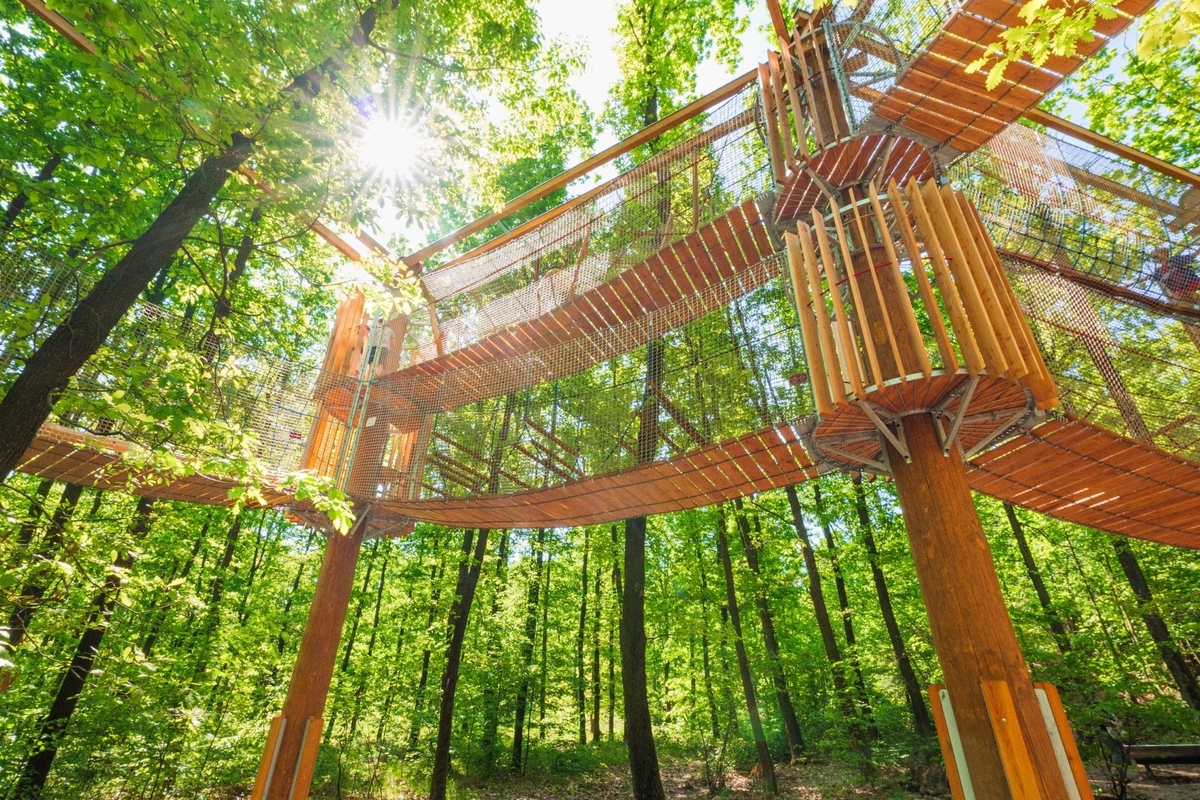
A tip on the side: Can’t decide between a rope course and a 3D maze? You don’t have to. The two can be combined into one attraction, perhaps topped off with a tube slide or a viewing tower. All it takes is skilled architects who know how to connect different types of attractions. Visitors can then choose for themselves: adrenaline on the ropes, or play in the nets.
Summary
A rope course is the right choice if you want to offer a sporting challenge and can staff it with trained instructors. If you are targeting families and want an attraction with high capacity and low running costs, a 3D maze comes out ahead. The key question is not which one is more fun. It is who will visit the attraction and how many people it will take to run it.